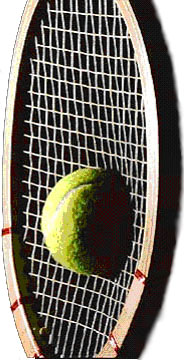
Understanding the Key Variables
The variables most affected by string tension in tennis physics are dwell time (t) and coefficient of restitution (c).
Dwell Time (t)
Dwell time is the length of time the ball stays on the strings during impact. Longer dwell time means the ball has more time to interact with the strings, which generally leads to better control and accuracy.
Coefficient of Restitution (c)
Coefficient of restitution measures the elasticity of the collision between the ball and the racquet. A higher c means a more elastic, livelier bounce - essentially what players refer to as "power" in their shots.
How String Tension Affects Performance
Longer dwell time (high t) results in lower torque and impulse reaction on impact, which translates to better accuracy. However, dwell time actually decreases with increasing string tension, which negatively affects accuracy.
Similarly, as string tension increases beyond a certain point, the coefficient of restitution (c) goes down. A lower c means higher shock transmission to the player's arm, resulting in increased shoulder pull, elbow crunch, and overall discomfort.
Research Insight from Dr. Jack Groppel
In his book High Tech Tennis (available from the USPTA bookstore), Dr. Jack Groppel shows that the conventional wisdom about string tension doesn't always match reality. While one might think the ball would stay on the strings longer with higher tension (because it flattens more), dwell time actually decreases with increasing string tension. See pp. 25-27 for detailed analysis.
Conventional Wisdom vs. Reality
- Conventional belief: More "power" (higher c)
- Reality: Higher bounce for oversized racquets up to 70 lbs
- Better for reducing shock to arm
- Can cause unpredictable string bed deformation
- Conventional belief: Better "control" (higher t)
- Reality: Dwell time actually decreases
- Easier to generate topspin
- More predictable ball rebound
The relationship between string tension and coefficient of restitution is not linear. For midsized racquets, there's a pronounced peak of bounciness at 60 pounds for gut strings and at 50 pounds for nylon strings.
Professional Preferences
There is no consensus among professional tennis players regarding optimal string tension, as evidenced by these legendary players:
Strung as tight as possible (85 lb.) on specially fortified racquets with two extra plies of reinforcement.
Preferred very low tension (44 lb) to enhance feel and touch, particularly for his volleying game.
Used a heavy, small-head racquet strung at 75 lb. to generate amazing topspin on his second serve.
The Real Reason Tight Strings Improve Control
Anecdotal evidence suggests there is truth to the rule that tight strings give better control, but not for the reason most people think. With a loose racquet - especially a big-head racquet - an off-center hit will deform the string bed more severely than it would with a tight, small-head racquet. This leads to less certainty about the path of the rebounding ball.
As Ronald Yepp points out, with a tight racquet, the ball is flattened more against the strings, making topspin easier to produce. This is particularly true with smaller racquet heads. Spin gives greater control, and greater spin is possible with tight strings.