
Abstract
The purpose of this research is to establish the relationship between the frequency parameters of free vibrations of a tennis string, its length, and the applied tension force.
This analysis provides a theoretical foundation for optimizing string tensioning to achieve consistent performance across the entire string bed of a tennis racket.
Problem Formulation
To solve this problem, we consider a single string of length L₀, rigidly fixed at both ends with a pre-tensioned force T₀. To simplify the solution procedure, we examine the vibration of a string with a concentrated mass m, which is significantly greater than the mass of the string itself.
The solution is constructed for elastic vibrations of small amplitude.
Mathematical Model
The calculation scheme of the problem is presented in Figure 1. Two forces act on the string displaced from equilibrium:
T = T₀ + ΔT - Elastic deformation forces of the string
m·d²x/dt² - Inertial force of mass m movement
Where:
T₀ - Initial static tension of the string
ΔT - Elastic component of string tension caused by its displacement
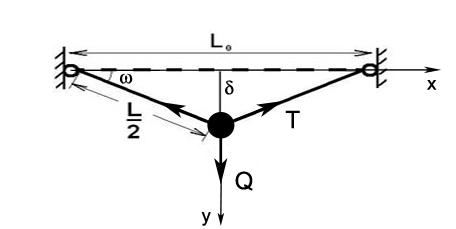
Fig. 1 - String vibration model with concentrated mass
Mathematical Derivation
Equation of Motion
The equation of motion for the considered model, neglecting the mass of the string itself and resistance forces, has the form:
Equation (1)
Small Oscillation Approximation
Considering small oscillations of the system, the deviation angle of mass m from the equilibrium position can be represented as:
Introducing an intermediate function ξ = dx/dt, we transform the differential equation:
Equation (2)
Integration and Boundary Conditions
Integrating appropriately and applying boundary conditions (zero velocity at maximum displacement), we obtain:
Equation (3)
Where x_max is the amplitude of oscillations.
Simplification for Small Angles
Considering the smallness of deviation angles, we simplify the equation to:
Equation (4)
Final Integration
Integrating equation (4), we find:
Equation (5)
Substituting the expression for ξ = dx/dt, we obtain:
Equation (6)
Frequency of Free Vibrations
Considering small oscillations, we can approximate:
Then the frequency of free vibrations is determined by the expression:
Key Result: Natural Frequency Formula
Equation (7)
Practical Application
Analyzing formula (7), we can derive practical applications of the obtained solution. Specifically, to ensure equal compliance of strings of different lengths, it is sufficient to maintain equality of their free vibration frequencies.
This principle allows for:
- Optimization of string tensioning patterns
- Consistent ball response across the string bed
- Improved control and predictability of shots
- Better energy transfer from racket to ball
The relationship between tension, length, and vibration frequency provides a scientific basis for stringing techniques that enhance racket performance and player control.
******************************************************************************************
This analysis establishes the fundamental relationship between string tension, length, and vibration frequency
for optimized tennis racket performance.