
Analysis of String Deformation in Tennis Rackets
Statistics show that the main parameters of a tennis racket are: power of the shot and control (accuracy) of the shot.
It is known that these parameters are determined both by the design features of the racket itself and by the mechanical characteristics of the strings. However, one of the most important parameters, namely shot control, is largely determined by the distribution of string flexibility in the transverse direction across the racket's surface.
Research Objective
This report presents a first attempt to construct an approximate model of elastic string deformation with the aim of obtaining recommendations for stringing technology.
To solve this problem, we consider the elastic problem of deformation of a single string rigidly clamped at both ends with an initial tension T₀ and length L₀.
Mathematical Model
By simulating the impact of the ball with the application of force F at the center of the string, we consider the deformation model presented in the figures.
Key Variables
T_total - Total string tension after applying force F
T₀ - Initial string tension
ΔT - Additional string tension caused by force F
k - Longitudinal compliance of the string
where: k = L₀/(E·A)
E - Elastic modulus of the string material
A - Cross-sectional area of the string
Deflection Analysis
The deflection at the center of the string is determined from the analysis of the deformed state of the string (Fig. 1).
where δ is the deflection at the center of the string, and L is the total length of the deformed string.
From the equilibrium condition of the node (Fig. 2), we obtain the equation:
where F is the transverse force caused by the ball impact.
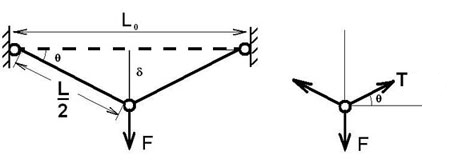
Fig. 1 & 2 - String deformation under impact force
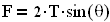
Force equilibrium at the impact point
Transverse Compliance Analysis
We define the transverse compliance of the string C at the point of force application F as the ratio:
For small deflections, where T₀ is significantly greater than ΔT, we can simplify the expression:
From formula (2) it follows that the constancy of the transverse compliance of the string is ensured by the constancy of the ratio T₀ to L₀:
Practical Conclusion
The obtained relationship (3) can be used as the basis for calculating all strings of the racket, starting from the initial tension value of the primary string. To ensure equal compliance of strings across the entire racket surface, it is necessary to maintain a constant ratio of their tension to their length.
This principle provides a theoretical foundation for optimizing stringing patterns to achieve consistent ball response across the entire string bed, which is crucial for shot control and accuracy in tennis.