Executive Summary
This document presents a Bayesian probabilistic framework designed to detect synthetic fraud by integrating behavioral and financial signals. Synthetic fraud—where fraudsters combine real and fabricated information to create fraudulent identities—poses a significant challenge to traditional detection systems. Our approach leverages Bayesian inference to dynamically update fraud risk assessments in real time, providing interpretable and actionable risk scores.
1. Introduction to Synthetic Fraud
Synthetic fraud represents an evolving threat in digital transactions. Unlike traditional identity theft, synthetic fraud involves creating new identities using a mix of legitimate and falsified data, making detection particularly difficult. Financial institutions, e-commerce platforms, and fintech companies require adaptive systems that can learn from new evidence and update risk assessments continuously.
2. Bayesian Inference in Fraud Detection
Bayesian methods provide a natural framework for fraud detection by:
- Incorporating prior knowledge (historical fraud rates)
- Updating beliefs as new evidence arrives
- Quantifying uncertainty through posterior probabilities
Bayes' Theorem Formulation
Where:
- Prior (\(P(\text{Fraud})\)): Initial belief about fraud likelihood
- Likelihood (\(P(\text{Evidence} \mid \text{Fraud})\)): Probability of observed evidence given fraud
- Posterior (\(P(\text{Fraud} \mid \text{Evidence})\)): Updated fraud probability after observing evidence
3. Signal Integration: Behavioral and Financial
Our framework combines two primary evidence streams:
Behavioral Signals
- Login frequency and patterns
- Device fingerprinting
- Session duration and navigation behavior
- Geographic login anomalies
Financial Signals
- Transaction velocity and amounts
- Payment method changes
- External Probability Layer (EPL) scores
- Historical transaction inconsistencies
4. Model Implementation & Visualization
The fraud detection model has been implemented in Python, utilizing probabilistic programming libraries for Bayesian inference. The system computes posterior fraud probabilities in real time, enabling immediate risk assessment and alert generation.
Posterior Fraud Probability Visualization
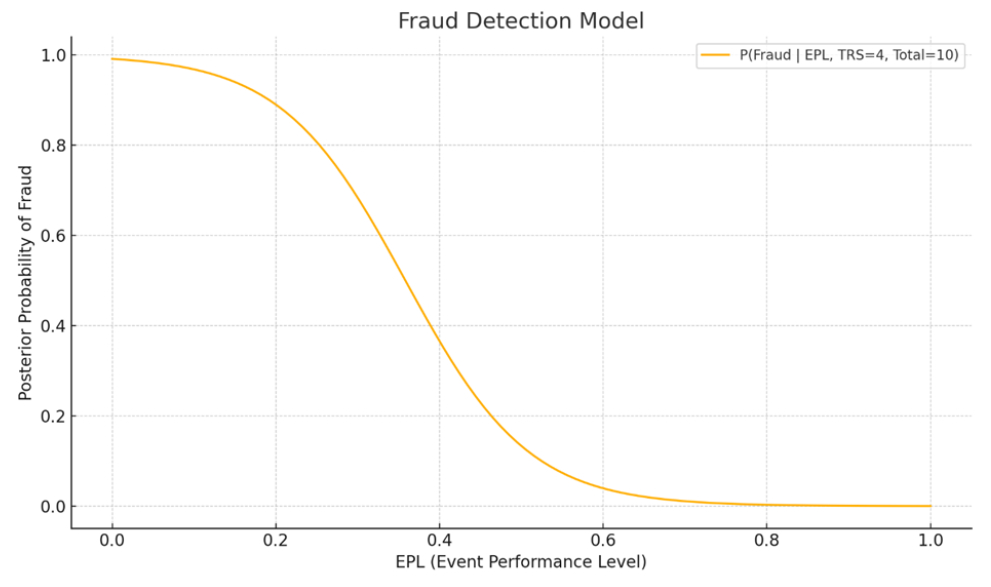
Figure: Time-series plot showing posterior fraud probability (orange line) derived from EPL scores. Peaks indicate high-risk intervals requiring investigation.
5. Key Benefits
Adaptability
New data sources can be integrated without retraining
Interpretability
Posterior probabilities provide clear risk scores
Real-Time Processing
Continuous updating as new evidence arrives
Reduced False Positives
Bayesian calibration improves precision
Auditability
Transparent reasoning process for compliance
6. Applications
This framework is applicable across multiple domains:
7. Future Enhancements
- Hierarchical Bayesian modeling for user segmentation
- Temporal dependency modeling via Bayesian networks
- Graph-based signal integration (social and transaction networks)
- Active learning for efficient labeling of uncertain cases
- Integration with explainable AI (XAI) techniques
8. Conclusion
The Bayesian framework presented here offers a robust, interpretable, and adaptive approach to synthetic fraud detection. By combining behavioral and financial signals within a probabilistic framework, organizations can achieve higher detection accuracy, lower false-positive rates, and improved operational efficiency in fraud prevention.
Keywords
Bayesian Inference, Synthetic Fraud, Fraud Detection, Behavioral Analytics, Financial Signals, Probabilistic Modeling, Machine Learning, Risk Scoring